

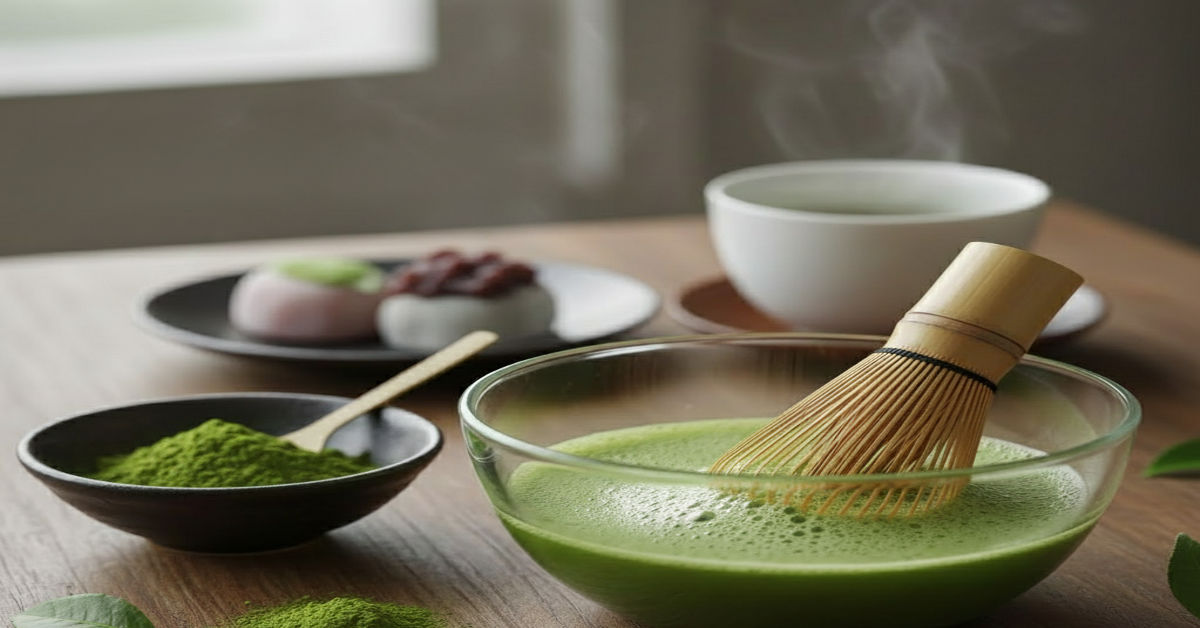
Ask what matcha tastes like and you will hear a chorus of answers: grassy, vegetal, sweet, bitter, creamy, savory, oceanic. None are wrong. Matcha—the powdered green tea long associated with Japanese tea ceremony—does not offer a single flavor so much as a spectrum, one that changes with origin, grade, and preparation. In its best expressions, matcha tastes both vivid and calm at once, like spring leaves and warm broth meeting on the tongue.
Within the first sip, most drinkers notice two things. First, a bright green freshness reminiscent of steamed spinach or freshly cut grass. Second a lingering savory depth—umami—that sets matcha apart from other teas. This combination explains why matcha can feel nourishing and indulgent even without sugar or milk. Poor-quality matcha by contrast can taste aggressively bitter, chalky or flat leading newcomers to wonder what the fuss is about.
Understanding matcha’s taste requires understanding how it is made. Unlike leaf-brewed green teas, matcha is produced from shade-grown tea leaves called tencha, stone-ground into a fine powder that is whisked directly into water. You ingest the entire leaf. That fact alone intensifies flavor, aroma, and mouthfeel—and magnifies both pleasures and flaws.
In the next sections, we’ll unpack what matcha tastes like by looking at its core flavor components, the chemistry behind them, how grade and terroir matter, and why preparation can turn the same powder from harsh to heavenly. Matcha’s flavor story is not just sensory; it is agricultural, historical and deeply human.
The First Impression: Green, Fresh, Alive
Good matcha announces itself visually before it ever reaches the mouth. Its color—an electric, almost unreal green—signals freshness and careful cultivation. That vibrancy translates directly into taste. The opening notes are typically vegetal and sweet-grassy, similar to young spring greens or sugar snap peas. Unlike black tea’s roasted or malty aromas, matcha’s freshness feels cool and luminous.
This “green” flavor is not accidental. Tea plants destined for matcha are shaded for about three to four weeks before harvest, reducing direct sunlight. According to the Encyclopaedia Britannica, shading increases chlorophyll production, deepening color and altering flavor chemistry (Encyclopaedia Britannica, 2024). Chlorophyll itself is not tasted directly, but its presence correlates with compounds that create fresh, plant-like notes.
As Harold McGee, food science writer and author of On Food and Cooking, has written, “Green teas owe their fresh, grassy notes to volatile compounds formed when leaves are minimally oxidized” (McGee, 2004). In matcha, where leaves are steamed and dried quickly, those compounds remain intact and concentrated.
For many first-time drinkers, this vegetal quality is the most striking aspect of matcha’s taste. It can feel refreshing, even cleansing—but it can also read as “too green” if expectations lean toward sweetness alone.
Umami: The Savory Heart of Matcha
If freshness is matcha’s greeting, umami is its soul. Often described as savory, brothy, or mouth-filling, umami gives matcha its depth and lingering finish. It is the same taste associated with dashi, miso, and aged cheeses, and it explains why matcha can feel satisfying without heaviness.
The umami in matcha comes primarily from L-theanine and glutamic acid. Shading the tea plant suppresses catechin formation (which causes bitterness) while boosting amino acids. As the National Institutes of Health notes, L-theanine is especially abundant in shade-grown green teas (NIH, 2023).
The concept of umami itself was first identified in 1908 by Japanese chemist Kikunae Ikeda, who described it as “a taste entirely distinct from sweet, sour, bitter, and salty” (Ikeda, 1909). Matcha is one of the most accessible ways to experience that distinction in beverage form.
This savory quality is why high-grade matcha is often compared to sweet corn soup or warm sea air rather than conventional tea. It coats the tongue gently and fades slowly, encouraging contemplation rather than quick consumption.
Sweetness Without Sugar
One of matcha’s most surprising qualities is its natural sweetness—subtle, but real. This sweetness does not announce itself like honey or fruit; instead, it emerges softly after the initial vegetal notes, especially in ceremonial-grade matcha.
Amino acids again play a role. L-theanine contributes not only umami but also a mild sweetness that balances bitterness. “High-quality green teas can taste sweet even in the absence of sugars,” explains Harvard Health Publishing, “because of their amino acid composition” (Harvard Health Publishing, 2022).
This sweetness is fleeting and refined. It disappears quickly, replaced by a clean finish rather than cloying aftertaste. In traditional Japanese tea practice, this is why matcha is often paired with wagashi, delicate sweets designed to heighten contrast rather than overwhelm.
Lower-grade matcha lacks this sweetness almost entirely. Without sufficient amino acids, bitterness dominates and any perceived sweetness comes only after sugar or milk is added.
Bitterness: A Necessary Counterpoint
Bitterness is not a flaw in matcha; it is a balancing force. In good matcha, bitterness appears briefly at the back of the tongue, sharpening the palate before giving way to umami. In poor matcha, bitterness overwhelms everything else.
The primary bitter compounds in matcha are catechins, particularly EGCG. Sun exposure increases catechin levels, which is why unshaded green teas tend to taste more astringent. Shading moderates this effect but does not eliminate it entirely.
According to the Food and Agriculture Organization of the United Nations, catechins are responsible for “astringency and bitterness in green tea infusions” (FAO, 2018). When balanced, these compounds add structure and complexity. When excessive, they create harshness.
Preparation matters here. Water that is too hot extracts bitterness aggressively. Traditional matcha preparation uses water around 70–80°C (158–176°F), allowing flavor to bloom without scorching.
Texture and Mouthfeel: More Than Taste
Matcha is not merely tasted it is felt. Because the powdered leaf is consumed whole, texture becomes a defining element. Well-prepared matcha feels creamy and smooth, almost velvety, with a fine foam on top. Poorly prepared matcha can feel gritty or chalky, disrupting enjoyment.
This mouthfeel contributes to matcha’s perceived richness. Unlike brewed tea, which is filtered, matcha suspends microscopic particles in liquid. These particles interact with saliva, extending flavor perception.
Ceramic bowls, bamboo whisks, and sifting are not aesthetic flourishes; they are functional tools designed to optimize texture. When texture is right, matcha’s taste feels integrated rather than fragmented.
How Grade Changes Taste
Not all matcha tastes the same. Grade matters profoundly.
| Matcha Grade | Typical Taste Profile | Common Uses |
| Ceremonial | Sweet, umami-rich, minimal bitterness | Traditional tea, drinking straight |
| Premium | Balanced, mild bitterness | Daily drinking, lattes |
| Culinary | Bitter, vegetal, robust | Baking, smoothies, cooking |
Ceremonial-grade matcha uses the youngest leaves, carefully processed to preserve amino acids. Culinary-grade matcha is often made from later harvests or blended for intensity rather than nuance. It is designed to stand up to sugar, dairy, and heat.
Confusing these grades is one of the most common reasons people misunderstand what matcha tastes like.
Terroir and Origin: Place on the Palate
As with wine or coffee, matcha reflects where it is grown. The most renowned regions—Uji, Nishio, and Yame in Japan—produce matcha with distinct flavor tendencies shaped by soil, climate, and tradition.
| Region | Flavor Tendencies | Notable Characteristics |
| Uji (Kyoto) | Deep umami, sweetness | Historic cultivation methods |
| Nishio (Aichi) | Bright green, mild bitterness | High production volume |
| Yame (Fukuoka) | Rich, full-bodied | Shaded mountain fields |
The Japanese Ministry of Agriculture notes that Uji has been producing matcha for over 800 years, refining shading and grinding techniques that emphasize sweetness and umami (MAFF, 2021). These regional differences are subtle but meaningful to experienced drinkers.
Why Matcha Tastes Different in Lattes
Many people encounter matcha first as a latte. Milk softens bitterness and highlights sweetness, often masking umami. This can make matcha more approachable—but also less representative of its traditional flavor.
Dairy proteins bind with catechins, reducing astringency. Plant milks add their own flavors from oat’s grainy sweetness to almond’s nuttiness. The result is a drink that tastes comforting and dessert-like, but less complex.
This is not a lesser experience—just a different one. Understanding matcha’s true taste often begins by drinking it plain at least once.
Takeaways
- Matcha tastes vegetal, savory, slightly sweet, and gently bitter—often all at once.
- Umami is the defining flavor, created by high amino acid content from shading.
- Quality and grade dramatically affect bitterness and sweetness.
- Preparation temperature and technique shape flavor as much as origin.
- Texture and mouthfeel are central to the experience, not secondary.
- Lattes soften matcha’s complexity but increase approachability.
Conclusion
Matcha’s taste resists simplification because it was never meant to be simple. It is an agricultural product shaped by shade and stone, by climate and ceremony, by chemistry and culture. To drink matcha is to participate—however briefly—in a lineage that values attentiveness over intensity, balance over spectacle.
For some, matcha’s grassy bitterness will always feel challenging. For others, its umami depth becomes quietly addictive. Both reactions are honest. What matters is context: the grade chosen, the water heated, the whisk lifted and lowered with care.
In an era of aggressively flavored beverages, matcha offers something rarer—a taste that unfolds rather than announces itself. It asks the drinker to slow down, to notice texture and aftertaste, to accept that pleasure can be subtle and still profound. In that way, matcha does not just taste a certain way. It teaches you how to taste.
FAQs
What does matcha taste like compared to green tea?
Matcha tastes more intense and savory because you consume the whole leaf, resulting in stronger umami, thicker texture, and less dilution.
Is matcha supposed to taste bitter?
A little bitterness is normal, but high-quality matcha should balance it with sweetness and umami, not overwhelm the palate.
Why does my matcha taste fishy or chalky?
This often indicates low-quality matcha, improper storage, or water that’s too hot extracting harsh compounds.
Does ceremonial-grade matcha taste better?
For drinking plain, yes. Ceremonial-grade matcha is smoother, sweeter, and less bitter than culinary grades.
Can matcha taste sweet without sugar?
Yes. High-quality matcha has natural sweetness from amino acids like L-theanine.
References
Encyclopaedia Britannica. (2024). Matcha. https://www.britannica.com/topic/matcha
Food and Agriculture Organization of the United Nations. (2018). Green tea processing and quality. https://www.fao.org
Harvard Health Publishing. (2022). Green tea and health. https://www.health.harvard.edu
Ministry of Agriculture, Forestry and Fisheries of Japan. (2021). Japanese tea production. https://www.maff.go.jp
National Institutes of Health. (2023). L-theanine. https://ods.od.nih.gov