
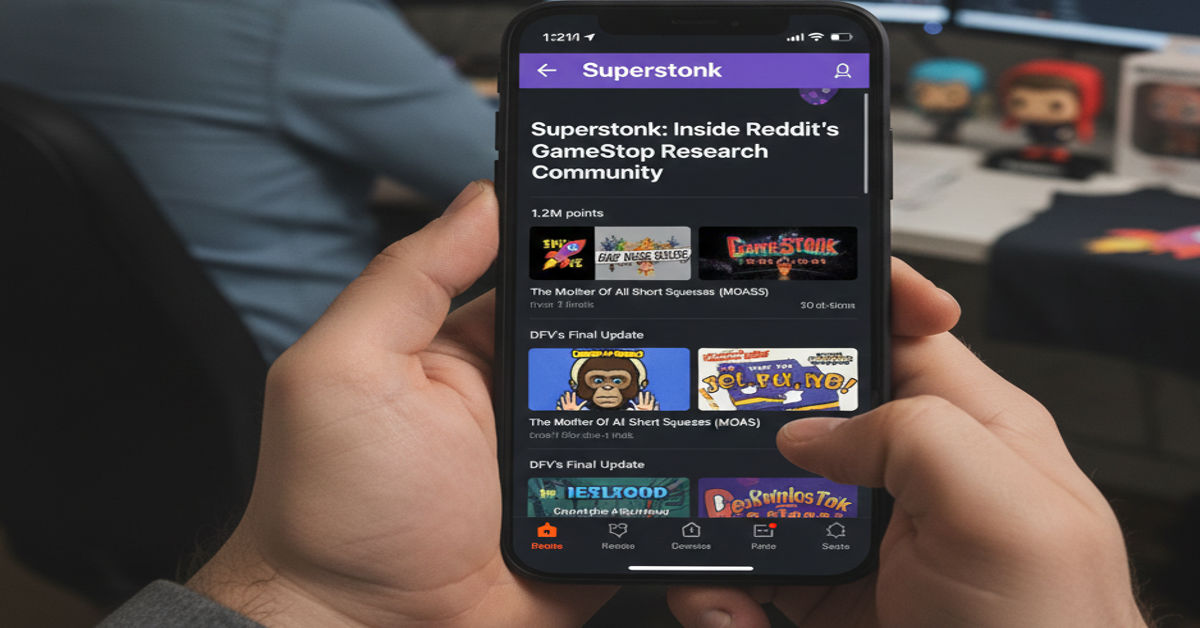
In the winter of 2021, as GameStop’s stock price convulsed and cable news struggled to keep up, a quieter but more consequential story unfolded on Reddit. r/Superstonk a subreddit that now counts roughly 1.2 million members emerged as a self-styled research collective devoted to understanding—and challenging—the mechanics of modern financial markets through the lens of GameStop ($GME).
The intent becomes clear: Superstonk is not merely about buying a stock. It is about interrogating short selling, payment for order flow, market transparency and the power imbalance between retail investors and Wall Street institutions. For many participants, $GME is the case study not the end goal.
The subreddit grew out of the chaotic aftermath of r/WallStreetBets’ GameStop moment, when moderation disputes and cultural fractures pushed users to form splinter communities. Superstonk positioned itself as more methodical, emphasizing original research—known internally as “DD” or due diligence—over pure speculation. Memes remained, but they served as cultural glue rather than the main product.
Five years later, Superstonk persists as a high-activity forum where trading volume anomalies, SEC filings, and short interest data are parsed line by line. It is also a place wary of impostors: moderators regularly warn against crypto projects and social media accounts attempting to exploit the name “SuperStonk” for scams.
To understand Superstonk is to understand how digital communities adapt after viral moments fade—and how distrust in financial institutions can harden into a durable, participatory worldview.
From WallStreetBets to Superstonk: A Digital Migration
Superstonk’s origin story is inseparable from r/WallStreetBets, the subreddit that propelled GameStop into the global spotlight in January 2021. As WSB ballooned from under two million users to more than eight million in weeks, moderation conflicts intensified. Posts were removed, moderators were replaced, and conspiracy theories flourished.
Out of that turbulence came a diaspora. First r/GME, then r/Superstonk, which launched in March 2021 with an explicit mission: focus narrowly on GameStop, maintain transparent moderation, and prioritize long-form research over hype. The name itself signaled escalation—“stonk” slang pushed into the absurd.
This migration reflected a broader pattern in online communities: when scale undermines trust, fragmentation follows. Superstonk’s early growth was fueled by a sense of exile and purpose. Members framed themselves as refugees from a corrupted space, now rebuilding something purer.
By mid-2021, Superstonk had become the primary venue for GameStop-focused discussion on Reddit, with daily post volumes rivaling much older financial forums. The community developed its own rituals, terminology, and internal celebrities—users known for exhaustive spreadsheet analysis or for translating SEC filings into plain English.
What Superstonk Actually Does All Day
Scroll through Superstonk on any given weekday and the diversity of activity is striking. There are screenshots of Bloomberg terminals, annotated graphs of trading volume, and meme images riffing on pop culture. The throughline is interpretation: what does today’s data mean for the GameStop thesis?
A typical high-engagement post might analyze short volume percentages from FINRA’s daily reports, compare them to historical averages, and speculate on hidden derivatives exposure. Others focus on GameStop’s corporate strategy under CEO Ryan Cohen, dissecting earnings calls and executive hires.
Moderators enforce strict rules against day trading advice or unrelated tickers. The idea is to reduce noise and maintain a shared investigative focus. Posts are flaired—DD, News, Speculation, Meme—allowing readers to self-select depth.
Importantly, Superstonk discourages coordination. There are no explicit calls to buy or sell. This distinction matters legally and culturally. Members often repeat a mantra: “I just like the stock,” a phrase that blends irony with a defensive posture against accusations of manipulation.
Theories, Skepticism and the Shadow of Short Selling
At the heart of Superstonk is a belief that GameStop’s stock has been subjected to excessive and opaque short selling. While official short interest declined after January 2021, many users argue that synthetic exposure persists through options, swaps, or offshore vehicles.
This skepticism aligns with findings in the U.S. Securities and Exchange Commission’s October 2021 Staff Report on equity market structure. As the report stated, “the events of January 2021 highlighted the role of social media in affecting trading activity, but a short squeeze did not appear to be the main driver of GameStop’s price movement” (SEC, 2021).
For Superstonk members, that sentence is endlessly debated. Some see it as vindication; others view it as incomplete. The community’s research often centers on perceived gaps between reported data and observed market behavior.
Susanne Trimbath, an economist and former DTCC advisory committee member, has argued publicly that failures-to-deliver deserve more scrutiny, stating that they represent “a structural weakness in the settlement system” (Trimbath, 2020). Her work is frequently cited in Superstonk discussions as foundational.
Key Moments in the Superstonk Timeline
| Date | Event | Significance |
| Jan 2021 | GameStop price surge | Catalyzed retail investor movement |
| Feb 2021 | r/GME growth | First major post-WSB migration |
| Mar 2021 | r/Superstonk founded | Focused, moderated alternative |
| Oct 2021 | SEC Staff Report | Official analysis of meme stock events |
| 2022–2024 | Continued DD activity | Sustained community engagement |
Memes as Social Infrastructure
While spreadsheets draw attention, memes sustain morale. Superstonk memes often remix financial jargon with humor creating a shared language that lowers barriers to entry. A newcomer might not understand options Greeks, but they understand a joke about “diamond hands.”
This cultural layer matters. Sociologist Zeynep Tufekci has written that online movements rely on affect as much as information, noting that “emotion is not the opposite of reason; it is often what makes reason actionable” (Tufekci, 2017). Superstonk exemplifies this blend.
Memes also function as soft moderation. Certain recurring jokes signal acceptable norms, while others mock behavior deemed reckless or misinformed. In this way, humor enforces boundaries without heavy-handed rules.
SEO, Search Intent and the Name “Superstonk”
Outside Reddit, “Superstonk” has become a searchable term associated with GameStop discourse. SEO tools like Semrush track its keyword profile, including search volume and competition, though exact public metrics are scarce. What is clear is that interest spikes around earnings, regulatory news, or sudden price movement.
The subreddit’s moderators are keenly aware of brand confusion. They regularly pin warnings against crypto tokens or websites using similar names. The concern is reputational: scams could undermine trust in the community’s research.
This vigilance reflects an understanding of how attention works online. Visibility attracts opportunists. Superstonk’s insistence on clarity—what it is and what it is not—is part of its longevity.
Superstonk Compared to Related Communities
| Feature | r/WallStreetBets | r/GME | r/Superstonk |
| Scope | Broad trading | GameStop-focused | GameStop-focused |
| Tone | High-risk humor | Transitional | Research-driven |
| Moderation | Loose | Moderate | Strict |
| Memes | Central | Secondary | Supportive |
Expert Perspectives on Retail Investor Communities
Market structure experts have increasingly taken online forums seriously. Former SEC Chair Jay Clayton noted in 2021 that “technology has democratized access to markets, but not necessarily understanding of them,” a tension visible in Superstonk’s educational efforts (Clayton, 2021).
Meanwhile, finance professor Emilios Avgouleas has argued that meme stock communities expose “a legitimacy gap in market governance,” where retail investors feel rules are enforced unevenly (Avgouleas, 2022). Superstonk’s persistence suggests that this gap remains unresolved.
These perspectives contextualize the subreddit not as an anomaly, but as a symptom of broader systemic unease.
Governance, Moderation and Internal Trust
Superstonk’s moderators are unusually visible. They publish rule changes, explain removals, and solicit feedback. This transparency is intentional, shaped by the perceived failures of earlier communities.
Trust is the subreddit’s most valuable currency. Without it, long-form research loses credibility. Moderators balance openness with firmness, banning users who promote unrelated assets or harass others.
The result is a space that feels simultaneously decentralized and tightly curated—a paradox that defines many successful online communities.
The Long View: Why Superstonk Endures
Most internet frenzies burn out. Superstonk has not. Its endurance stems from its framing: this is not a trade, but an investigation. Members speak in years, not days.
GameStop’s business transformation—closing stores, investing in e-commerce, exploring new revenue streams—provides ongoing material. So do regulatory developments around market transparency and settlement cycles.
Whether or not Superstonk’s more ambitious theories prove correct, the community has already influenced discourse. Terms like “naked shorting” and “failures-to-deliver” now appear regularly in mainstream coverage, a shift from pre-2021 norms.
Takeaways
- Superstonk emerged from moderation-driven migrations after the 2021 GameStop surge.
- The subreddit emphasizes research and theory over explicit trading advice.
- Memes function as cultural glue and informal governance tools.
- Skepticism toward short selling and market transparency drives engagement.
- Expert analysis increasingly treats such communities as structurally significant.
- The name “Superstonk” has become both a brand and a vulnerability.
Conclusion
Superstonk occupies a liminal space between fandom, activism, and financial analysis. It is not a hedge fund nor a protest movement, nor a joke—though it borrows elements from all three. Its members are united less by certainty than by suspicion a shared belief that something in the market’s plumbing does not add up.
In that sense, Superstonk reflects a broader moment. Trust in institutions has frayed, and the tools to interrogate them are widely available. Reddit, for all its chaos, provides a venue where motivated amateurs can assemble, teach one another, and persist long after headlines move on.
The GameStop trade may one day resolve into a historical footnote. Superstonk, however, offers a case study in how digital communities metabolize shock into structure. It shows how memes can coexist with meticulous analysis, and how collective curiosity can sustain itself without a clear endpoint.
Whether viewed as quixotic or prescient, Superstonk has already changed how retail investors see themselves: not as spectators, but as participants in the ongoing story of markets.
FAQs
What is Superstonk?
Superstonk is a Reddit subreddit focused on in-depth discussion and analysis of GameStop stock and market structure issues.
How is it different from WallStreetBets?
Superstonk is narrower in scope, more strictly moderated, and emphasizes research over high-risk trading humor.
Does Superstonk give financial advice?
No. The community discourages explicit buy or sell recommendations and frames discussion as educational.
Why does Superstonk warn about crypto scams?
Some projects misuse similar names to exploit the subreddit’s visibility, prompting moderators to issue warnings.
Is Superstonk still active?
Yes. As of 2025, it remains highly active, especially around GameStop earnings and regulatory news.
References
Avgouleas, E. (2022). The governance of financial markets in the age of social media. University of Edinburgh School of Law. https://www.ed.ac.uk
Clayton, J. (2021). Testimony on market volatility. U.S. Securities and Exchange Commission. https://www.sec.gov
Securities and Exchange Commission. (2021). Staff report on equity and options market structure conditions in early 2021. https://www.sec.gov