

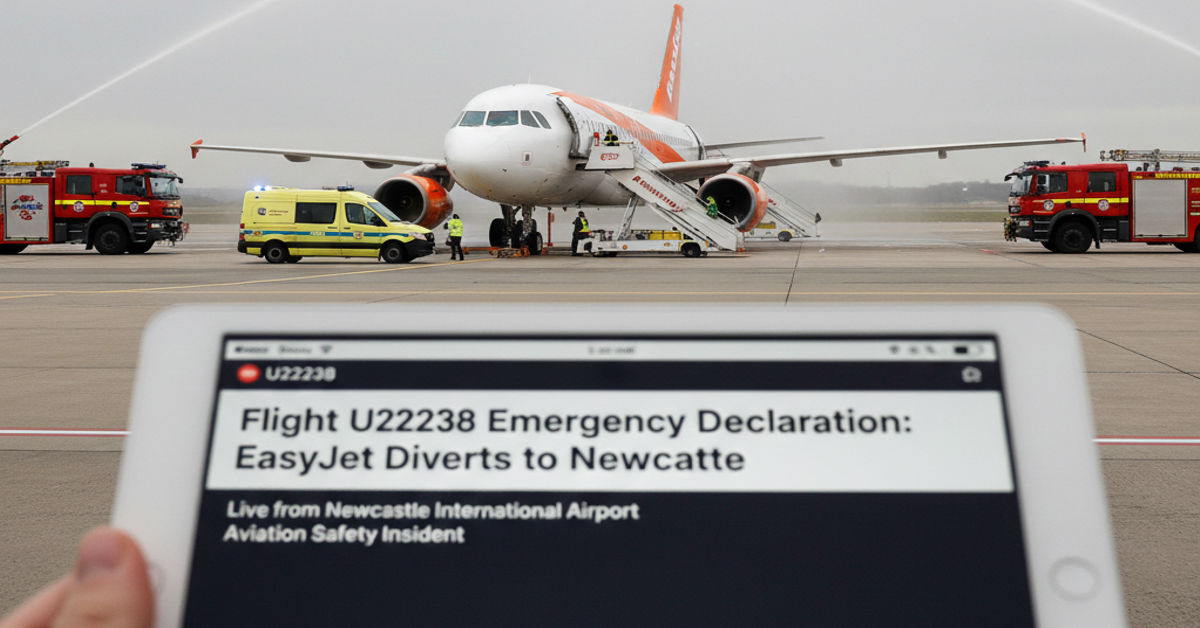
On October 27, 2025 EasyJet flight U22238, also tracked as EZY2238, faced an unexpected emergency shortly after departing Copenhagen (CPH) for Manchester (MAN). Departing at 22:13 CET, about 28 minutes later than scheduled, the Airbus A320 climbed to its cruising altitude over the North Sea. The routine flight was interrupted when a passenger experienced a serious welfare issue prompting the flight crew to activate a squawk 7700 emergency. This universal aviation signal immediately alerted air traffic control that the aircraft was in distress and required priority handling. The crew’s quick action exemplified standard aviation protocol, prioritizing passenger safety above all else.
The decision led to a diversion to Newcastle Airport (NCL) chosen for its proximity and readiness to handle emergencies. The aircraft, registered as G‑EZPB, landed safely on Runway 25 at 22:52 GMT, where emergency medical personnel awaited the passenger in need of immediate care. After approximately one hour on the ground, the aircraft resumed its journey, arriving in Manchester at 00:28 GMT the following day. EasyJet later confirmed that the diversion was due to a passenger welfare matter and no injuries were reported among passengers or crew.
The flight U22238 emergency declaration underscores how aviation safety protocols function in real time. While such diversions are relatively uncommon, they demonstrate the coordinated efforts of flight crews, air traffic control and ground emergency teams. This incident also highlights the complex balance between passenger well-being and operational efficiency in modern air travel.
Understanding the Emergency and Response
The flight crew’s immediate response was crucial. At 38,000 feet, the Airbus A320 was cruising when the emergency unfolded. Activation of squawk 7700 signaled to all nearby air traffic controllers that the flight faced a serious situation. This code ensures the aircraft receives priority clearance for descent, routing, and landing. Although the exact medical condition of the passenger was not publicly disclosed, the crew and ATC collaborated seamlessly to divert the flight to the nearest suitable airport.
Newcastle Airport’s preparedness played a vital role. Emergency services, including paramedics, were ready to meet the aircraft upon landing. The aircraft spent roughly an hour on the ground to ensure the passenger received proper medical attention before continuing to Manchester. This combination of airborne vigilance and ground coordination reflects the structured safety culture embedded in commercial aviation.
Timeline of Flight U22238 Emergency Declaration
| Time (Local) | Event |
| 21:45 CET | Scheduled departure from Copenhagen Airport (CPH). |
| 22:13 CET | Flight U22238 departs Copenhagen. |
| 22:30 CET | Passenger welfare issue arises; crew declares emergency with squawk 7700. |
| 22:52 GMT | Aircraft lands safely at Newcastle Airport (NCL) on Runway 25. |
| 23:50 GMT | Flight resumes after passenger care. |
| 00:28 GMT (Oct 28) | Aircraft arrives at Manchester Airport (MAN). |
This timeline demonstrates how the flight crew and air traffic control managed the incident efficiently ensuring both safety and minimal disruption.
Aircraft Details and Operational Context
Flight U22238 was operated by an Airbus A320‑200, registration G‑EZPB, part of easyJet’s narrow-body fleet. The aircraft had been operational since 2016 and is widely used for European short- to medium-haul routes. The A320’s design includes advanced avionics, medical kits, and automated emergency protocols that assist the crew during unforeseen incidents. Regular maintenance ensures that aircraft systems remain reliable, which in this case allowed the emergency to be addressed without technical complications.
Expert Perspectives
“A diversion due to a medical emergency highlights the flexibility and training of airline crews,” says Dr. Maria Chen, an aviation safety consultant. “The swift decision to squawk 7700 and divert demonstrates adherence to well-established safety protocols.”
Captain Robert Hayes, a former airline captain, adds, “Crew training ensures passenger safety is always prioritized. Diversions like U22238 are handled professionally to minimize risk and provide immediate care.”
Aviation safety analyst Peter Lund observes, “The collaboration between the crew, ATC, and Newcastle emergency teams illustrates how aviation systems integrate multiple layers of protection for rare, unpredictable events.”
Comparisons with Other Diversions
| Flight Event | Cause | Outcome |
| U22238 (Oct 27, 2025) | Passenger welfare issue | Diverted to Newcastle; continued to Manchester safely |
| Another easyJet flight (Oct 2025) | Technical door warning | Emergency landing in Munich; safe resolution |
| Various European flights (2025) | Medical diversions | Managed by nearby airports with emergency teams |
This table illustrates that while diversions are uncommon, passenger welfare is a priority across the airline industry.
Passenger and Crew Experience
For passengers, the emergency diversion may have caused anxiety. Flight announcements are typically measured to provide transparency while preventing panic. Apps and tracking platforms indicated an unexpected route change, prompting curiosity and concern. The crew managed communications carefully, maintaining calm and reassuring passengers. Crew preparedness, including first aid and AED training, was crucial in addressing the situation effectively.
Takeaways
- The flight U22238 emergency declaration reflects immediate prioritization of passenger welfare.
- Activation of squawk 7700 ensures rapid coordination with air traffic control.
- Diversion airports are prepped for quick medical response.
- Crew training and onboard medical resources are critical in emergencies.
- Effective communication between crew and passengers minimizes panic.
- Aircraft maintenance and operational reliability underpin safe diversions.
Conclusion
The flight U22238 emergency declaration is a case study in modern aviation safety. From the moment the passenger’s condition was identified, coordinated actions by the crew, air traffic control, and Newcastle emergency services ensured a safe and swift resolution. The incident demonstrates the intricate systems, training, and protocols that prioritize human life above schedule or convenience. Though rare, such events underscore that commercial aviation’s operational complexity includes both technical precision and a deep commitment to passenger care. U22238’s diversion reminds travelers that, while emergencies may arise, the airline industry is structured to respond decisively and protect lives at every altitude.
FAQs
What caused the flight U22238 emergency declaration?
A passenger welfare issue prompted the crew to declare an emergency and divert the flight to Newcastle Airport.
Were there any injuries?
No injuries were reported; the passenger received immediate medical care upon landing.
Which airport handled the emergency?
Newcastle Airport (NCL) received the aircraft, providing emergency medical services.
Did easyJet issue an official statement?
Yes, easyJet confirmed the diversion was due to urgent medical attention for a passenger.
What is the aircraft registration and history?
The aircraft was an Airbus A320‑200, registered G‑EZPB, in service with easyJet since 2016.
References
- AIRLIVE Contributors. (2025, October 28). easyJet flight U22238 to Manchester declared an emergency and diverted to Newcastle. https://airlive.net/emergency/2025/10/28/easyjet-flight-u22238-to-manchester-declared-an-emergency-and-diverted-to-newcastle/
- EasyJet flight from Copenhagen to Manchester makes emergency landing in Newcastle after ‘passenger welfare issue’. (2025, December 2). https://www.thesun.co.uk/news/37143470/flight-copenhagen-manchester-emergency-landing/
- Reddit: r/flightradar24. (2025, October). EZY emergency over the north sea. https://www.reddit.com//r/flightradar24/comments/1ohsnx5
- easyJet flight U22238. (2025, October). https://www.travelandtourworld.com/news/article/tag/easyjet-flight-u22238/
- EasyJet.com Flight Tracker. (2026). https://www.easyjet.com/en/flight-tracker