

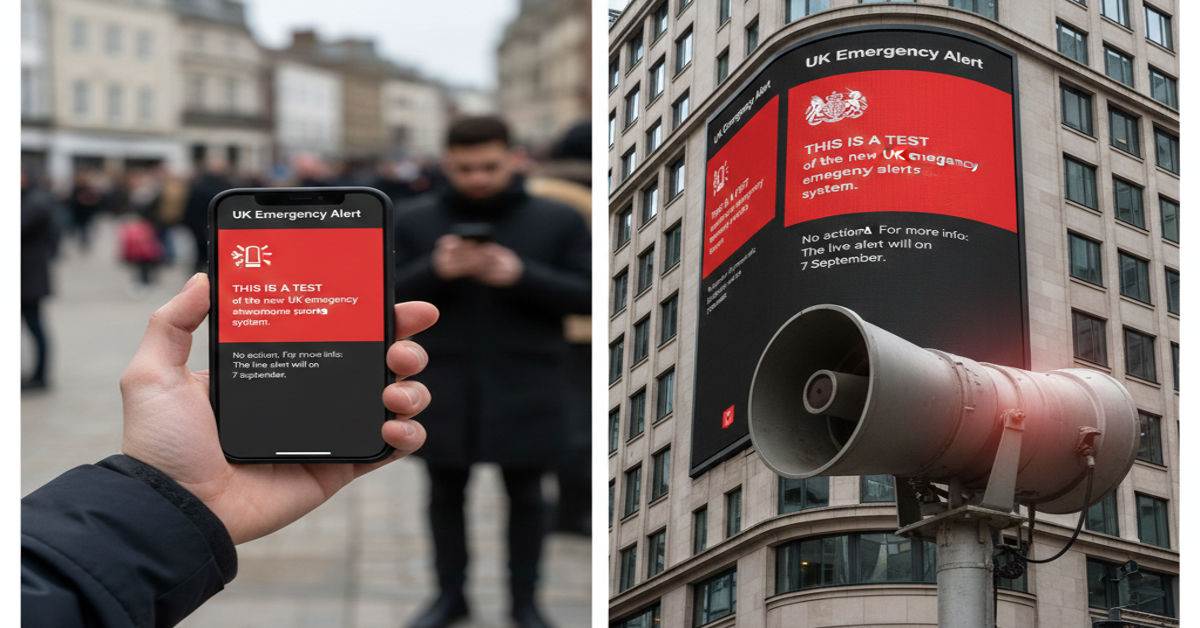
On Sunday, 7 September 2025 the UK Government to Test Emergency Alerts System nationwide, delivering a clear demonstration of the country’s commitment to public safety and emergency preparedness. At approximately 3 pm BST compatible 4G and 5G mobile phones and tablets will emit a loud siren‑like sound, vibrate and display a message on-screen for roughly ten seconds. The alert will reach devices even if they are on silent and no action will be required from users. This second national test following the system’s debut in April 2023 is designed to confirm that the technology functions properly and that the public is familiar with its alerts.
The Emergency Alerts system is a central part of the UK’s strategy for life-threatening situations such as extreme weather events, floods or other immediate dangers. It allows government and emergency services to reach citizens quickly ensuring vital instructions are disseminated efficiently. Public response to prior tests and real emergency deployments including the Storm Éowyn warnings earlier in 2025, highlights the importance of system familiarity. Experts note that such preparedness can significantly improve response times and reduce confusion during real emergencies.
Background and Purpose of Emergency Alerts
The Emergency Alerts system was introduced to provide the UK population with rapid, reliable warnings during critical incidents. Unlike conventional SMS messages, which require individual phone numbers, the system uses cell broadcast technology to reach every compatible device in the affected area. This ensures messages are received even without mobile data or Wi-Fi connections.
The 7 September test is part of an ongoing program to improve the reach and effectiveness of the system. Dr. Helen Broomfield, a UK resilience specialist, explains, “Familiarity with alerts is crucial. When people have experienced the siren and on-screen message, they are more likely to understand the urgency and act promptly during a real emergency.”
How the Emergency Alerts System Works
The system operates through cell broadcast technology, sending messages from mobile masts to all devices within a designated area. Alerts override silent modes, ensuring that even muted devices receive notifications. Users do not need to take action to receive alerts, and messages include official guidance, usually directing recipients to gov.uk/prepare for further instructions.
| Feature | Description |
| Delivery Method | Cell broadcast, targeting geographic areas |
| Network | Compatible with 4G and 5G networks |
| Device Compatibility | Most modern iOS and Android devices |
| User Action | None required |
| Silent Mode | Overrides silent and vibrate settings |
| Data Requirement | No mobile data or Wi-Fi needed |
Despite its broad reach, some devices, such as those switched off, connected only to older networks, or incompatible models, may not receive the alert. This underlines the importance of widespread device adoption for community safety.
Timeline of UK Emergency Alerts
| Date | Event |
| 2019–2021 | Localised cell broadcast tests in selected regions |
| 23 April 2023 | First nationwide Emergency Alerts test |
| 2023–2025 | Partial real deployments for emergencies such as Storm Éowyn |
| 7 September 2025 | Second national test of the Emergency Alerts system |
The timeline illustrates how the system has evolved from localized tests to nationwide deployments, reflecting growing public safety needs and technological capability.
Public Reaction and Expert Perspectives
Public reaction to emergency alerts has been mixed. Many individuals treat the alerts as routine but informative, while others reflect on broader issues of safety, accessibility, and preparedness. Charities, especially those supporting vulnerable groups, highlight potential risks for survivors of domestic abuse, who may rely on phones for safety.
Marcus Golding, a technology commentator, states, “Emergency alerts save lives, but we must ensure they are inclusive and consider vulnerable populations. Clear guidance and accessible opt-out options are essential.” Similarly, Professor Liam Todd, a risk communication expert, notes, “Regular testing builds public trust and ensures that when alerts are issued for real emergencies, people respond calmly and effectively.”
Preparing for Emergency Alerts
The UK Government to Test Emergency Alerts System on 7th September provides guidance to citizens on how to prepare for emergencies. This includes practical checklists, instructions for families, and advice for responding to floods, extreme weather, or other hazards. While users can opt out of alerts through device settings, retention of alerts is strongly recommended to ensure personal safety.
| Preparation Measure | Details |
| Opt-Out Settings | iOS: Notifications; Android: Emergency Alerts section |
| Safety Guidance | Accessible at gov.uk/prepare |
| Real-Time Updates | Provided during actual emergencies |
| Public Awareness | National tests and campaigns promote familiarity |
Regular testing, as on 7 September, helps users understand the alert system and ensures that safety protocols are widely known.
Key Takeaways
- The UK government will test the Emergency Alerts system nationwide on 7 September 2025.
- Alerts are delivered using cell broadcast technology, overriding silent and vibrate modes.
- The system has been used in real emergencies, including extreme weather events.
- Experts highlight the importance of public familiarity with alerts to improve safety.
- Vulnerable populations may require special consideration for alerts and opt-out options.
- Devices not compatible or switched off will not receive alerts.
- Government guidance for preparedness is available at gov.uk/prepare.
Conclusion
The UK Government to Test Emergency Alerts System on 7th September is more than a technical exercise—it represents a key step in public safety preparedness. By sending simultaneous alerts to millions of devices, the government aims to ensure that citizens can quickly recognize and respond to threats, from extreme weather to other life‑threatening events. While challenges remain regarding accessibility and privacy for vulnerable populations, the system underscores the importance of clear, direct, and rapid communication. As emergency scenarios grow increasingly complex, nationwide tests such as this help reinforce public trust, familiarity, and readiness for the unexpected.
FAQs
What time will the Emergency Alert test occur?
The national test is scheduled for 3 pm BST on 7 September 2025.
Will my phone ring if it is on silent?
Yes, the alert overrides silent and vibrate modes.
Who can issue Emergency Alerts?
Only the UK government and designated emergency services.
Can I opt out of receiving alerts?
Yes, users can disable alerts in their device settings, though retention is recommended.
Why does the UK conduct nationwide alert tests?
To ensure the system functions correctly and the public is familiar with the alerts in real emergencies.
References
Cabinet Office. (2025). Emergency Alert Test: Frequently Asked Questions. UK Government. https://www.gov.uk/government/news/emergency-alert-test-frequently-asked-questions
Cabinet Office. (2025). National Emergency Alert test to be held on 7th September. UK Government. https://www.gov.uk/government/news/national-emergency-alert-test-to-be-held-on-7th-september
ITV News. (2025, September 6). Domestic abuse charities warn survivors ahead of emergency alert test. https://www.itv.com/news/2025-09-06/domestic-abuse-charities-warn-survivors-ahead-of-sundays-emergency-alert
The Guardian. (2025, September 7). Millions of UK mobiles activated as government tests national alert system. https://www.theguardian.com/uk-news/2025/sep/07/millions-of-uk-mobiles-activated-as-government-tests-national-alert-system
Yahoo News UK. (2025). Emergency alert reminder issued as exact time confirmed. https://uk.news.yahoo.com/emergency-alert-reminder-issued-exact-163632498.html