

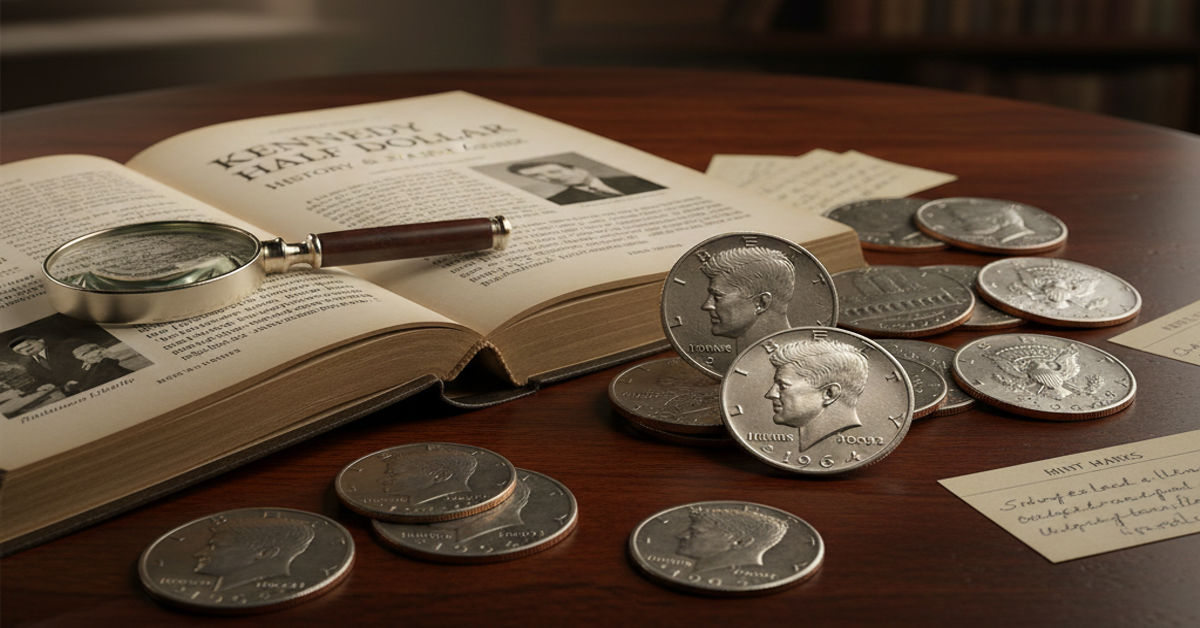
The Kennedy half dollar is one of the most recognizable coins in modern American numismatics a 50‑cent piece struck in memorial to President John F. Kennedy within months of his assassination in 1963. Authorized by Congress at the end of that year and rushed into production in early 1964 the Kennedy half dollar combined emotional resonance with practical currency utility and immediately captured the public’s attention. Lines formed at banks across the country as eager Americans sought these new coins as keepsakes of a beloved leader whose life was cut short.
You’ll understand what makes the Kennedy half dollar both a historical artifact and a numismatic curiosity its genesis in national grief its fluctuating metal content from silver to base metals driven by economics and policy and the way collectors today value specific dates and varieties. Over 4 billion Kennedy halves have been minted since 1964 yet few are seen in everyday circulation with many held by collectors investors or quietly tucked away in attic jars.
Across decades the coin’s story intersects with broader currents in American life including silver shortages rising bullion prices shifts in consumer behavior and the evolving role of government in coinage. For collectors and curious Americans alike the Kennedy half dollar reveals how a small piece of metal can carry deep cultural meaning as well as real material value.
The Birth of an Icon: Why the Kennedy Half Dollar Came to Be
Just days after President Kennedy’s assassination on November 22 1963 Treasury and U.S. Mint officials began planning a commemorative coin to honor him. With Jacqueline Kennedy’s guidance the half dollar was chosen over other denominations to avoid displacing another president on the nation’s coinage and to allow a quicker transition. Gilroy Roberts and Frank Gasparro adapted designs from a presidential medal to craft the obverse portrait and reverse presidential seal that debuted on the new coin.
Congress authorized the piece on December 30 1963 and by January 1964 the first dies were completed and strikes made in Denver and Philadelphia. When the coins were officially released on March 24 1964 banks ran out of initial shipments by noon, with limits of 40 pieces per customer quickly exhausted. Demand far outstripped expectations as Americans hoarded the new halves both as keepsakes and for their precious metal content.
The coin’s design has endured with remarkably little change in more than half a century except for the bicentennial issue of 1975–76 which replaced the presidential seal with a depiction of Independence Hall and added the dual dates “1776–1976.”
Silver to Clad: Compositional Changes and What They Mean
The Kennedy half dollar’s composition tells a story of shifting economics. The 1964 issue was struck in 90% silver and 10% copper—the last regular‑issue U.S. half dollar to use that high silver content. Rising silver prices and domestic shortages prompted the Coinage Act of 1965 which dramatically reduced silver in circulating coins. From 1965 through 1970 halves were struck in 40% silver clad with copper cores while continuing to feature Kennedy’s image.
From 1971 onward standard circulation issues eliminated silver entirely transitioning to a copper‑nickel clad composition familiar to modern collectors and spenders. Over the years limited silver proof issues returned, notably 90% silver proofs from 1992 through 2018 and .999 silver proofs beginning in 2019 for collectors.
These shifts reflect broader monetary trends. As silver became more valuable on commodity markets it became impractical for circulating coinage, leading the U.S. Mint to prioritize durability and cost effectiveness. For collectors the silver content defines key segments of the Kennedy series and lays the foundation for much of its market value.
Metal Composition of Kennedy Half Dollars
| Year Range | Composition | Silver Content | Notes |
| 1964 | 90% silver, 10% copper | 0.3617 oz | First issue |
| 1965–1970 | 40% silver clad | 0.1479 oz | Reduced content |
| 1971–present | Copper‑nickel clad | 0 | No silver |
| 1992–2018* (proof) | 90% silver | Varies | Collector proofs |
| 2019–present* (proof) | 99.9% silver | Varies | Modern proofs |
*Proof issues sold to collectors not for general circulation.
Why Collectors Care: Value Factors and Rare Varieties
For collectors and investors the Kennedy half dollar’s value is often driven first by silver content and then by rarity and condition. A circulated 1964 half dollar typically trades above face value because of its 90% silver, with values tied to current silver prices and collector demand. Similarly 40% silver coins from 1965–1970 usually garner modest premiums but are more plentiful.
Specific dates and mint mark combinations can command significant premiums. The 1970‑D 40% silver coin for example had limited distribution making it a semi‑key date in the series. Proof and special mint set coins—especially those with unique finishes such as Proof‑69 or varieties like the early “Accented Hair” proofs from 1964—are highly prized by advanced collectors.
Grading by professional services such as PCGS or NGC can dramatically affect prices, with high‑grade specimens sometimes selling for thousands of dollars. This makes careful identification and certification vital for serious numismatists.
Representative Market Values (Indicative)
| Type | Typical Value Range | Notes |
| 1964 circulated | $8–$20+ | Based on silver content |
| 1965–1970 circulated | $5–$15+ | 40% silver |
| Modern clad (post‑1971) | $0.50–$5 | Condition dependent |
| Proof/collector issues | $10–$500+ | Varieties and finish matter |
| Rare high grades | Hundreds–$10,000+ | Exceptional specimens |
*Market values vary daily and depend on condition grading and collector interest.
Expert Perspectives
Numismatic experts emphasize the dual nature of the Kennedy half dollar as both coinage and cultural artifact. As coin historian Q. David Bowers notes the series reflects American responses to national events as much as monetary policy. In the words of coin market analyst David W. Lange the Kennedy half dollar “bridges the gap between circulating coinage and commemorative remembrance.”
Collector community voices also note the emotional resonance of these coins, suggesting that “owning a well‑preserved Kennedy half is like holding a tangible piece of 1960s America.”
The Kennedy Half Dollar in Everyday Life
Despite its iconic status the half dollar has seldom been widely used in day‑to‑day transactions since the 1970s. Its large size and limited use in vending machines and cash transactions have confined it largely to rolls held by banks and to collector sets. Production for general circulation dwindled after 2001 with the Mint focusing on collector demand until shipments resumed to the Federal Reserve in 2021.
For many Americans the half dollar remains a curiosity found in change jars or coin boards rather than everyday commerce. Yet its presence underscores ongoing conversations about the future of physical currency in a digital age.
Takeaways
• The Kennedy half dollar was created in 1964 as a tribute to President John F. Kennedy.
• Its design by Gilroy Roberts and Frank Gasparro endures with minimal change.
• Silver content shifted from 90% to 40% and eventually to base metals due to economic pressures.
• Collector value hinges on composition rarity and condition.
• Proof and special issues offer additional collecting depth.
• The coin’s circulation use declined after the 1970s.
• Even common halves can connect collectors to history.
Conclusion
More than fifty years after its debut the Kennedy half dollar remains a fascinating intersection of history economics and numismatics. Born from national mourning it quickly became a sought‑after keepsake and later a staple of coin collections around the world. Its changing composition reflects broader shifts in monetary policy and commodity markets while its enduring design honors a president whose legacy continues to captivate. From silver hoards to clad pocket change the Kennedy half dollar tells a complex story of American identity and value perception. For collectors the coin is both an entry point into numismatic study and a reminder that even everyday objects can carry profound cultural significance.
FAQs
What years of Kennedy half dollars contain silver?
Kennedy halves from 1964 are 90% silver; 1965–1970 are 40% silver. Special proof and collector issues later also include silver.
Why did silver content change?
Rising silver prices and shortages led Congress to reduce then eliminate silver to control costs and preserve circulating coinage.
Are all Kennedy half dollars valuable?
Only those with silver content rare mint marks or high grades tend to have value above face. Most post‑1971 clad coins trade near nominal.
What is the bicentennial Kennedy half dollar?
Coins dated 1776–1976 feature a special reverse showing Independence Hall and were issued to celebrate America’s 200th anniversary.
How can I identify a silver Kennedy half dollar?
Check the date and edge: silver coins date 1964–1970 with distinct edges; later proofs have mint marks and finishes indicating silver.
REFERENCES
U.S. Mint. (n.d.). Kennedy Half Dollars. US Mint. Retrieved January 2026, from https://www.usmint.gov/coins/coin-programs/kennedy-half-dollars
National Park Service. (2024). Minting a legacy: The history of the Kennedy half dollar. NPS. Retrieved January 2026, from https://www.nps.gov/articles/000/minting-a-legacy-the-history-of-the-kennedy-half-dollar.htm
Wikipedia contributors. (2025). Kennedy half dollar. In Wikipedia, The Free Encyclopedia. Retrieved January 2026, from https://en.wikipedia.org/wiki/Kennedy_half_dollar
U.S. Coin & Paper Money Values – Coin World. (2025). 1964 Kennedy half dollar. Coin World. Retrieved January 2026, from https://www.coinworld.com/coinvalues/half-dollar/1964-kennedy-half-dollar.html
HalfDollarCoinsWorth.com. (2025). Rare half dollar coins: Kennedy silver and commemorative values. Retrieved January 2026, from https://halfdollarcoinsworth.com/