

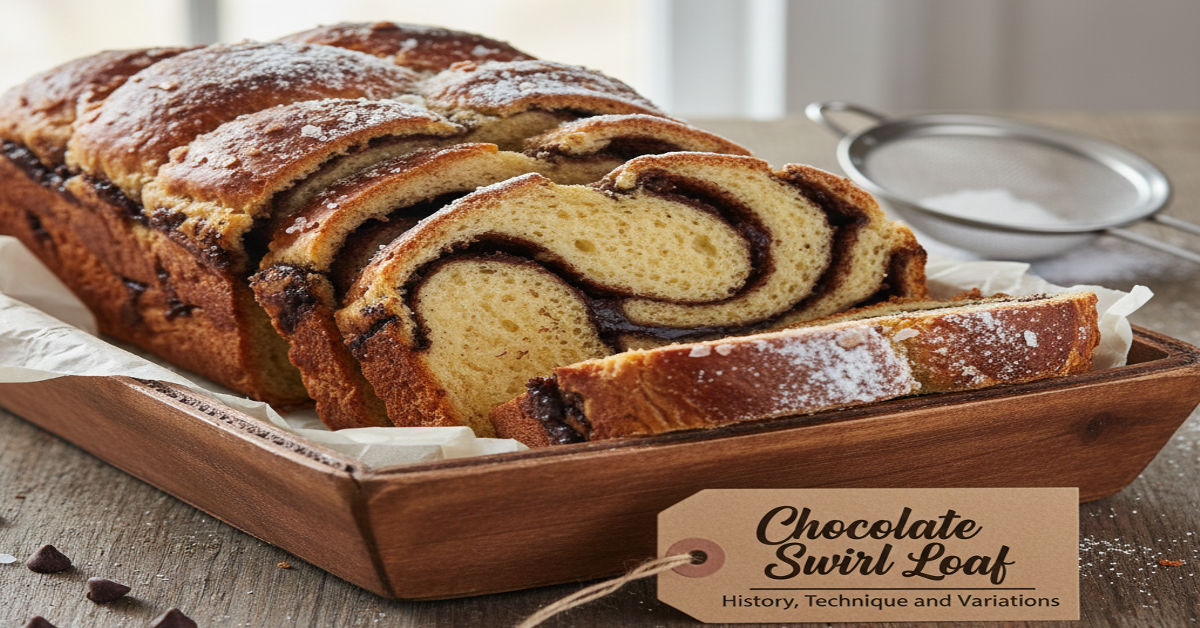
Few baked goods manage to feel both modest and celebratory but a loaf with a chocolate swirl does exactly that. It looks unassuming from the outside—bronzed crust, familiar loaf-pan silhouette—but sliced open, it reveals dark, glossy ribbons folded through tender crumb. In the first bite, there is the comfort of bread and the indulgence of chocolate neither overpowering the other.
For home bakers searching for a reliable yet impressive project, the chocolate swirl loaf answers the call. It relies on pantry staples—flour, yeast, milk, butter, sugar—yet rewards care and patience with striking marbling and a soft shreddable interior. The loaf is versatile enough for breakfast toast, French toast or dessert and sturdy enough to keep for days without staling quickly.
The intent is clear: this is a guide to understanding what makes a chocolate swirl loaf work, how it’s shaped, and why certain techniques matter. Unlike quick breads, this is a yeasted loaf that benefits from fermentation, gluten development and thoughtful shaping. The chocolate element may come from melted dark chocolate, cocoa-enriched dough or finely chopped bars that melt into streaks during baking.
Behind the simplicity lies a quiet complexity. From Eastern European holiday breads to Japanese milk bread adaptations, the chocolate swirl loaf has evolved across cultures. Its enduring appeal rests not on novelty, but on balance: bitterness and sweetness, structure and softness, restraint and pleasure.
A Brief History of Swirled Breads
Swirled breads predate chocolate by centuries. European bakers in the 17th and 18th centuries layered spices, dried fruits, or honey into rolled doughs long before cocoa became widely available. Chocolate itself entered European baking in earnest in the 19th century, following industrial-scale processing that made cocoa powder and solid bars affordable.
By the early 20th century, enriched yeasted breads with fillings—such as babka in Eastern Europe and pan dulce variations in Latin America—began incorporating chocolate. According to food historian Gil Marks, babka emerged as a way to use leftover challah dough, rolled with cinnamon or chocolate and baked for Sabbath or holidays (Marks, 2010).
In Romania and surrounding regions, festive loaves known as cozonac introduced chocolate alongside walnuts, rum, and citrus zest. Meanwhile, in Japan, postwar baking culture fused European techniques with milk-heavy doughs, resulting in ultra-soft loaves that later adopted cocoa swirls for visual contrast.
What unites these traditions is not extravagance, but practicality. Swirling allowed bakers to distribute small amounts of luxury ingredients throughout a loaf, maximizing flavor impact. Today’s chocolate swirl loaf continues that lineage, translating frugality into elegance.
The Science of Dough and Chocolate
Chocolate swirl loaves succeed or fail at the intersection of fermentation and fat. Yeast thrives in warm, slightly sweet environments, producing carbon dioxide that lifts the dough. Chocolate, however, introduces cocoa solids and cocoa butter—both of which can interfere with gluten formation if mismanaged.
“Fat coats flour proteins, limiting gluten development,” explains Harold McGee, author of On Food and Cooking, noting that enriched doughs require longer kneading to achieve structure (McGee, 2004). This is why chocolate fillings are typically layered after the initial rise, rather than mixed fully into the dough.
Temperature also matters. Dark chocolate melts between 88°F and 93°F, meaning it softens during proofing and fully liquefies in the oven. This melting creates the characteristic ribbons, but excessive moisture or sugar can cause leaking or collapsed layers.
Cocoa powder offers an alternative. When incorporated into a portion of dough, it delivers color and bitterness without added fat. King Arthur Baking notes that Dutch-process cocoa, with its neutral pH, integrates more smoothly into yeast doughs than natural cocoa (King Arthur Baking, 2022).
The result is controlled contrast: a loaf that rises evenly while maintaining visual definition.
Key Ingredients and Their Roles
| Ingredient | Function | Notes |
| Active dry yeast | Leavening | Bloom in warm milk (100–110°F) |
| Milk | Tenderizes crumb | Whole milk preferred |
| Flour | Structure | Bread flour adds chew |
| Sugar | Sweetness, yeast food | Balance prevents over-browning |
| Eggs or yolks | Richness | Optional but common |
| Butter | Flavor, softness | Softened, not melted |
| Dark chocolate or cocoa | Swirl flavor | 60–70% cacao ideal |
Flour choice shapes the loaf’s personality. Bread flour yields taller slices and a chewy crumb, while all-purpose flour produces a softer, cake-like texture. Eggs deepen color and tenderness but are not mandatory; many European versions omit them entirely.
Chocolate selection matters more than quantity. Bittersweet chocolate offsets the sweetness of enriched dough, preventing the loaf from tasting cloying. As pastry chef Joanne Chang has said, “Chocolate should read as flavor, not filling” (Chang, 2016).
Shaping for Marbling: Technique Over Decoration
The swirl is not decorative excess; it’s structural. After the first rise, dough is rolled into a rectangle, spread thinly with butter and chocolate filling, then rolled tightly into a log. Tension is key. Loose rolling creates gaps; over-tightening forces filling out the sides.
Some bakers slice the log lengthwise and twist the halves together, exposing layers for dramatic contrast. Others prefer a single-roll method for cleaner spirals. Both approaches work, provided the dough is well-rested and elastic.
A second rise allows the loaf to relax and expand, sealing layers together. Baking at 350°F for 35–40 minutes sets the crumb while allowing chocolate to melt without scorching. An internal temperature of 190°F signals doneness.
As the Culinary Institute of America teaches, “Shaping determines crumb as much as mixing” (CIA, 2011). In a chocolate swirl loaf, shaping is the difference between muddy streaks and distinct ribbons.
Variations Across Cultures
| Style | Distinguishing Features | Origin |
| Babka | Twisted, dense, rich | Eastern Europe |
| Cozonac | Citrus zest, rum, walnuts | Romania |
| Milk bread swirl | Ultra-soft, layered | Japan |
| Rye-chocolate loaf | Earthy bitterness | Northern Europe |
Modern bakers adapt freely. Cinnamon, coconut sugar, or espresso powder deepen flavor. Rye flour adds nuttiness; tangzhong paste increases moisture retention. Vegan versions substitute plant milks and oils with minimal compromise.
What persists is the visual language: dark against light, repetition within variation.
Storage, Serving and Longevity
Chocolate swirl loaves age gracefully. Butter and sugar slow staling, while chocolate retains moisture. Wrapped tightly, the loaf keeps at room temperature for three days and freezes well when sliced.
To serve, toast thick slices until edges crisp and chocolate softens. For dessert, pair with lightly sweetened whipped cream or mascarpone. Coffee, black tea, and even dry red wine complement the bitterness of dark chocolate.
As baker and author Rose Levy Beranbaum notes, “Bread is at its best when reheated gently—never rushed” (Beranbaum, 2016). Patience applies even after baking.
Takeaways
- Chocolate swirl loaves balance enriched dough with restrained sweetness.
- Swirling distributes flavor efficiently and creates visual impact.
- Chocolate should be layered, not fully mixed, to protect gluten structure.
- Cultural variations reflect local ingredients and festive traditions.
- Proper shaping and proofing matter more than decoration.
- Bittersweet chocolate provides depth without overpowering.
- The loaf improves with rest and gentle reheating.
Conclusion
A loaf with a chocolate swirl is less about spectacle than intention. It rewards bakers who slow down—who let dough rise fully, who roll with care, who understand that contrast is built layer by layer. In an era of maximalist desserts, the swirl loaf remains quietly confident, offering pleasure without excess.
Its endurance across cultures speaks to a universal instinct: to take something everyday and make it special through attention rather than extravagance. Whether sliced for breakfast, shared over coffee, or tucked into a freezer for later, the chocolate swirl loaf carries with it a lineage of thrift, celebration, and craft.
In the end, its appeal lies not only in taste, but in the reveal. Each slice is slightly different, a reminder that handwork leaves traces—and that those traces are often the point.
FAQs
What chocolate works best for swirl loaves?
Bittersweet chocolate (60–70% cacao) melts cleanly and balances sweet dough without overwhelming it.
Can I use cocoa powder instead of chocolate?
Yes. Cocoa can be mixed into part of the dough for defined swirls with less fat.
Why did my swirl leak out?
Overfilling or rolling too tightly can force melted chocolate out during baking.
Is bread flour necessary?
No, but it produces a taller loaf with chewier texture than all-purpose flour.
Can the loaf be frozen?
Yes. Slice first, wrap tightly and freeze up to two months.
References
King Arthur Baking. (2022). Baking with cocoa powder. https://www.kingarthurbaking.com
New York Times Cooking. (2019). Chocolate babka techniques. https://cooking.nytimes.com